




















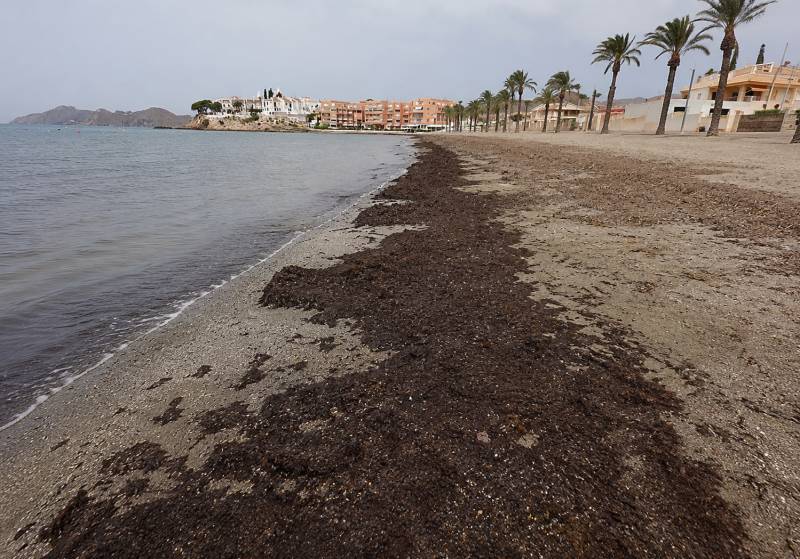
New restrictions on how washed-up Posidonia seagrass can be managed on beaches across the Region of Murcia are leading to growing complaints and confusion over who is responsible for dealing with it.
The changes follow a Royal Decree introduced in April that gives greater protection to Mediterranean seagrass meadows, banning activities such as anchoring boats, dumping waste, building industrial facilities and installing structures that could damage them.
However, the legislation is also affecting the Region's beaches. Councils must now submit management plans and obtain permission before moving washed-up seagrass, which cannot just be removed and disposed of but must be relocated elsewhere on the same beach.
Rather than treating Posidonia oceanica and Cymodocea nodosa as beach waste, the new legislation recognises the important role they play in protecting the coastline from erosion.
As a general rule, washed-up seagrass should be left undisturbed. The only exception is during the official bathing season, from March 15 to October 15, when councils are allowed to remove dried seagrass from all beaches. Wet seagrass, however, must remain where it is.
So far, only Águilas and Mazarrón have submitted the required management plans. Águilas has applied for permission to manage seagrass on the beaches of Calabardina and La Cola, while Mazarrón has submitted plans covering 15 beaches.
When the legislation was introduced, Spain's Ministry for Ecological Transition indicated that regional governments would review applications and grant permission through their environmental departments.
However, the Murcia regional government disagrees and has asked the central government to amend the law. It says the build-up of washed-up seagrass is creating safety concerns, particularly for people with reduced mobility and young children.
Officials from Murcia's Regional Ministry for the Environment say the Royal Decree now requires the regional government to issue reports for seagrass removal on its beaches, something that was not previously necessary.
They also argue that applications should still require final approval from the State Coastal Authority (Costas), which is responsible for deciding whether moving the seagrass could increase coastal erosion.
Costas, however, says responsibility lies with Murcia's Regional Ministry for the Environment. Despite this, Costas did previously give its approval when Águilas Council sought guidance several months ago.
As beaches across the Costa Cálida fill with residents and tourists during July, many have been surprised by the amount of Posidonia washed up along the shoreline.
The rules have only been in force for a few months, but complaints have increased as the summer has progressed.
This weekend, residents in La Manga raised concerns about the build-up of both wet and dry seagrass on Levante Beach, with some saying it made walking across parts of the sand difficult. Similar scenes were also reported in La Azohía.
Cartagena City Council says it has already submitted its beach maintenance plan for the period 2026-2029 to the State Coastal Authority. Under that plan, Posidonia continues to be managed following the approved procedure.
The council says the seagrass is removed, left to dry, screened to separate the sand, and cleared away three or four times a week.
Meanwhile, residents in Calabardina have organised volunteer clean-up events, moving washed-up Posidonia further up the beach rather than removing it completely.
Image:Archive
Sign up for the Spanish News Today Editors Roundup Weekly Bulletin and get an email with all the week’s news straight to your inbox
Special offer: Subscribe now for 25% off (36.95 euros for 48 Bulletins)
Read some of our recent bulletins:
Discount Special Offer subscription:
36.95€ for 48 Editor’s Weekly News Roundup bulletins!
Please CLICK THE BUTTON to subscribe.
(List price 3 months 12 Bulletins)